
3.1 Eligible Employee
Employees are eligible for tuition remission on their first day of employment, provided they are full- or part-time (exempt or non-exempt) and eligible for benefits. Employees who are not eligible for full benefits are not eligible for tuition remission under this policy.
3.1(a) University service requirement
Employees who receive tuition remission are required to maintain a service commitment to Converse University following graduation or upon ceasing enrollment. Employees must remain continuously employed by the University for one (1) year for each academic year in which tuition remission benefits were received. Employees who voluntarily separate from the University before fulfilling the required service commitment may be required to repay, in accordance with University procedures and applicable law, all or a prorated portion of the tuition remission benefit received.
The post-enrollment service commitment requirement shall apply only to tuition remission benefits awarded for coursework beginning with the Fall 2026 term. Tuition remission benefits awarded prior to the effective date will not be subject to retroactive repayment or service obligations. However, any tuition remission benefits received after the effective date will be subject to the service commitment requirements outlined in this policy.
The service requirement does not apply to tuition remission received for dependents (undergraduate) and spouses (graduate).
3.2 Employee Category
3.2(a) Exempt Employee
An employee who meets Fair Labor Standards Act (FLSA) requirements to be exempt from overtime pay and occupies an executive, administrative, or professional position, as defined under the FLSA. Non-instructional exempt employees receive compensation at a minimum salary that meets the requirements set under South Carolina code and the FLSA.
3.2(b) Non-Exempt Employee
An employee who does not meet the Fair Labor Standards Act (FLSA) requirements to be exempt from overtime pay and who is paid for all overtime hours worked in any workweek.
3.2(c) Resignation or Termination
Tuition remission benefits cease upon an employee's resignation from or termination by the University. If resignation or termination occurs during the refund period as defined by the academic calendar, tuition remission will be reduced by a proportionate amount.
3.3 Enrollment Status
3.3(a) Traditional Undergraduate and Converse II students
Enrollment status for traditional undergraduate and Converse II students is determined based on the following enrollment per term:
1-5 credits less than half-time
6-8 credits half-time
9-11 credits three-quarter time
12 or more credits full-time
It is expected that traditional undergraduate students are enrolled full-time to be eligible for tuition remission. Traditional undergraduate students enrolled less than full-time will not be eligible for tuition remission.
3.3(b) Graduate Students
A graduate student is considered full-time in a given academic term or session when enrolled in six credit hours or more. A graduate student is considered less than half-time in a given academic term or session when enrolled in fewer than six credit hours. Summer sessions will be combined to determine enrollment status.
3.3(b)1 Professional Leadership Doctoral Students
The EdD in Professional Leadership is designed to be taken in a specified progression over 3 years. It would be difficult for employees, spouses, and dependents to complete the program in 6 or more years if they take only one class per semester/session. Instead, if the course sequence is followed, employees will receive a discount of over 50% and complete the program in 3 years. The structure of the program is as follows:
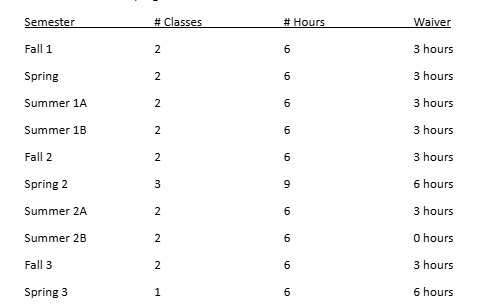
Employees and spouses may end up paying for 27 of 60 hours under this plan (a discount of more than 50%). Employees, spouses, and dependents who persist through the final course (Capstone in Spring 3) will receive the final 6-hour class as part of tuition remission.
Any unique or extenuating circumstances that warrant a proposed exception to the EdD program's tuition remission policy require the approval of the Dean of the Graduate School and the Vice President for Operations & CFO.
3.3(c) Effects of Drops and Withdrawals for Converse II and Graduate Students
Converse II and Graduate tuition remission recipients must maintain enrollment in all courses for which the benefit is paid. If a recipient drops or withdraws from a course for which tuition remission has been paid, the tuition remission will be reduced by the cost of the course.
For example, a graduate student registers for six credit hours at $575 per credit hour, for a total benefit of $3,450. The student withdraws from one three-credit course during the semester. The tuition remission benefit will be reduced by $1,725 or by the cost of the three-credit course, whichever is greater.
The recipient is responsible for repayment of all costs incurred by such reversal.
Signatures on the Tuition Remission application verify that the student/employee has read, understands, and agrees to abide by the policies and procedures set forth herein.
3.4 Intent to Enroll
Intent to enroll refers to a student's subsequent-semester enrollment status during the summer session. A student is said to demonstrate “intent to enroll” during the summer session if the student is registered for the subsequent fall semester, and to demonstrate “intent to enroll.” New students demonstrate “intent to enroll” during the summer term if they are admitted to a degree program that begins the subsequent semester.
This policy is effective beginning with the Fall 2026 semester for newly enrolling students. Students currently enrolled who were receiving benefits under a prior policy will have their eligibility determined by that policy.
3.5 International Student
An international graduate student is a graduate student who holds an F-1 or J-1 visa. International students are not eligible for tuition remission.
3.6 Definition of a Spouse
A spouse is defined as “a person in a legally contracted marriage recognized by the State of South Carolina to a Converse University employee, with the exception of an estranged spouse who maintains a separate domicile.”
3.7 Definition of a Dependent
A “dependent” is defined as the son/daughter, stepson/stepdaughter, or legally adopted son/daughter of an eligible Converse University employee who is under the age of 24 and is claimed as a dependent on the employee’s federal income tax return for the year(s) in which the tuition remission is requested.
Dependent students over the age of 24 are eligible for reduced tuition benefits as Converse II students and are not eligible for tuition remission.
Dependent students enrolled in graduate programs are not eligible for tuition remission.
3.8 Student Account
A student account is the University billing statement assigned to a student and maintained by the University’s Student Accounts Office.
4 Responsibilities and Procedures
4.1 Description
Tuition remission provides financial assistance for eligible Converse University employees, their spouses, and/or dependents who are enrolled as degree-seeking students in traditional undergraduate, Converse II, or graduate programs. Eligible Converse employees may also receive tuition remission as non-degree-seeking students for professional development coursework that is directly related to their job duties and responsibilities at the University.
4.2 Limitations & Exclusions
4.2(a) Traditional Undergraduate Students
Degree-seeking traditional undergraduate students will be eligible for the value of full-time tuition and a $2,000 credit toward housing and meals (if a campus resident) for the academic year in which the student is enrolled. Tuition remission does not cover fees (matriculation, lab, music lessons, etc.).
Dependent tuition remission benefits cease when an employee resigns from or is terminated by the University.
Please note: All other grant/scholarship aid awarded from federal, state, or institutional sources will be deducted from tuition before calculating the value of the tuition remission. Students with scholarships from outside organizations not affiliated with the University (i.e., Ruritans, church organizations) may use outside financial aid to assist with room and board expenses (if living on campus). Tuition remission may not be used for fees, room and board, or other expenses.
4.2(b) Converse II Students
Degree-seeking Converse II spouses/dependents will be eligible for the value of tuition for up to twelve (12) credits in the Fall/Spring terms and six (6) combined credits for all summer terms.
Employees who are Converse II students will be eligible for no more than three (3) credit hours per term of enrollment.
4.2(c) Graduate Students
Degree-seeking graduate students will be eligible for no more than three (3) credit hours in the Fall/Spring terms, and no more than one three (3) credit hour class per summer term. For example, if a Graduate student is enrolled in six credit hours in Summer I and six credit hours in Summer II, the Graduate student would be eligible for a total of six (6) credit hours of tuition remission.
4.2(d) Enrollment limitations
An employee/spouse/dependent may enroll in an appropriate course if space is available and at least 6 students are already enrolled. One may elect to enroll in a class of fewer than eight full-time equivalent (FTE) students. Tuition remission students may not receive tuition remission for directed independent studies (DIS) courses and internships. Employees granted enrollment in a DIS (Directed Independent Study) will be charged the published tuition rate.
Employee/Spouse/Dependent may receive tuition remission for one degree in each of the following categories:
- Undergraduate degree
- Master’s degree (employee and/or spouse only)
- Doctorate (employee and/or spouse only)
Tuition remission benefits may be used for only one degree program at a time. Students may not receive tuition remission benefits for a degree program and professional enhancement courses simultaneously.
4.2(e) Employee Supervisor Approval
The employee must obtain their supervisor's approval before enrolling in each course. Some employees in certain positions may not be allowed to take courses during regular office hours. Office schedules cannot be altered to allow employees to attend classes, and class schedules cannot be changed to accommodate them.
Employees must make up any time they miss from work to attend a class during working hours.
4.3(f) Employee Death or Total and Permanent Disability
In the event of an employee’s death or total and permanent disability, the University will extend tuition remission benefits based on the following criteria:
- The employee must have been employed full-time or part-time with benefits at Converse University for the last seven (7) consecutive years immediately prior to the time of death or total disability in order to qualify their dependents.
- The dependent(s) are only eligible for a traditional undergraduate degree at Converse University.
- The dependent/parent must complete the Free Application for Federal Student Aid (FAFSA) using Converse’s school code (003431) by June 1st of each year for which the tuition remission is being requested.
- This benefit grants tuition only. Dependents must pay all other course fees and expenses, including reservation fees, room and board fees, books, and other extra costs such as lab or directed independent study fees.
- The dependent(s) must meet eligibility requirements as established by the institution.
- The dependent(s) at the time of the death or total disability must have completed the 10th grade.
- This benefit has no cash value.
- The subsequent remarriage of a surviving spouse has no bearing on this benefit.
- This benefit does not extend beyond the dependent's age of 24 years.
4.2(g) Exclusions
- Directed Independent Study (DIS) courses are not eligible for tuition remission.
- Off-campus courses are not eligible for tuition remission.
- Any course requiring Converse to pay for the teaching of a tuition remission student is not eligible for tuition remission (i.e., Acadeum courses).
- The Master's in Marriage and Family Therapy program is not eligible for tuition remission.
- Fees (term access, lab, music lessons, etc.) are not eligible for tuition remission.
4.3 Admission
An employee, spouse, and/or dependent must be admitted into a regular degree-seeking program prior to the start of the academic term for which tuition remission is requested and must remain a regular degree-seeking student during the award period.
4.3(a) Free Application for Federal Student Aid (FAFSA) Requirement
All employees/spouses/dependents must complete the FAFSA each academic year for which the tuition remission benefit is requested. The FAFSA must be completed by June 1st of each year for the upcoming year. Employees/spouses/dependents who do not complete the FAFSA will not be eligible for tuition remission.
Applications can be completed at https://studentaid.gov/ and must include Converse University (school code #003431) as a recipient of the information.
Graduate students are not required to complete the FAFSA to receive tuition remission benefits.
4.4 Funding Source(s)
The source or sources used to fund a graduate assistantship must be under the University's control and, in the University's judgment, appropriate for assistantship support.
4.5 Payment of Tuition
The payment of tuition remission is considered a scholarship that offsets all of the following costs charged to the student account during the contract period of the assistantship:
Total tuition based on the enrollment and limitations expressed above (number of credit hours waived) as per the Schedule of Tuition and Fees. Additional fees are the student's responsibility.
4.5(a) Taxable Benefit
According to IRS regulations, the value of the tuition remission benefit may be taxable for employees, their spouses, and dependents. The value of the benefit will be reflected on the employee’s W-2 form at the end of the year. The University encourages the employee to consult a tax advisor for more information.
Automatic Termination of Benefit
The University will automatically terminate the tuition remission benefit if:
- The employee/spouse/dependent completes the degree program
- The employee/spouse/dependent voluntarily withdraws or is administratively withdrawn from the degree program
- The employee is terminated, resigns, or otherwise leaves the employment of the University prior to the start of the academic term for which the tuition remission is to be applied
4.7 Administrative Authority
4.7.1 Basic Terms and General Management Procedures
4.7.1(a) Basic Terms
The Vice President for Operations & CFO, the Associate Vice President and Director of Human Resources, and the Associate Vice President for Student Financial Services have the authority to establish and modify the basic terms for tuition remission benefits.
4.7.1(b) General Management Procedures
The Vice President for Operations and CFO and the Associate Vice President for Student Financial Services have the authority to develop and maintain general management procedures for tuition remission benefits.
The Associate Vice President for Student Financial Services has the authority to calculate the value of the tuition remission benefit for each academic term for which the employee/spouse/dependent qualifies.
4.7.2 Local Terms and Management Procedures
An academic or administrative unit of the University does not have the authority to develop local terms and management procedures for tuition remission.
5 Required Forms
Application for Dependent Tuition Remission for Traditional Undergraduates
- The form must be completed annually by the employee
- Most recent federal 1040 tax returns must be provided, verifying that the student is claimed as a dependent by the Employee
Application for Employee/Spouse/Dependent Tuition Remission for Converse II and Graduate students
- The form must be completed for each term for which the benefit is requested
- The most recent federal Form 1040 tax returns must be provided to verify that the employee and spouse have filed as “married filing jointly” or “married filing separately.”
The purpose of tuition remission benefits is to provide financial assistance and enhance educational and developmental opportunities for Converse University employees, their spouses, and/or dependents while supporting the University in its teaching, research, and service missions. This policy explains the guiding principles, defines the basic terms, and establishes the administrative authority for all tuition remission benefits.
To establish the guiding principles, basic terms, and administrative authority for tuition remission.
This policy applies to all employees of Converse University, their spouses, and/or dependents.
Version History
Applications are accessible via my.converse.